R134A, R1234YF & R744 DE-GASES & RE-GASES YOU CAN RELY ON
MTA Approved || 30+ Years Experience || Same-Day bookings || Courtesy Cars Available || Expert Technicians || Backed By VASA
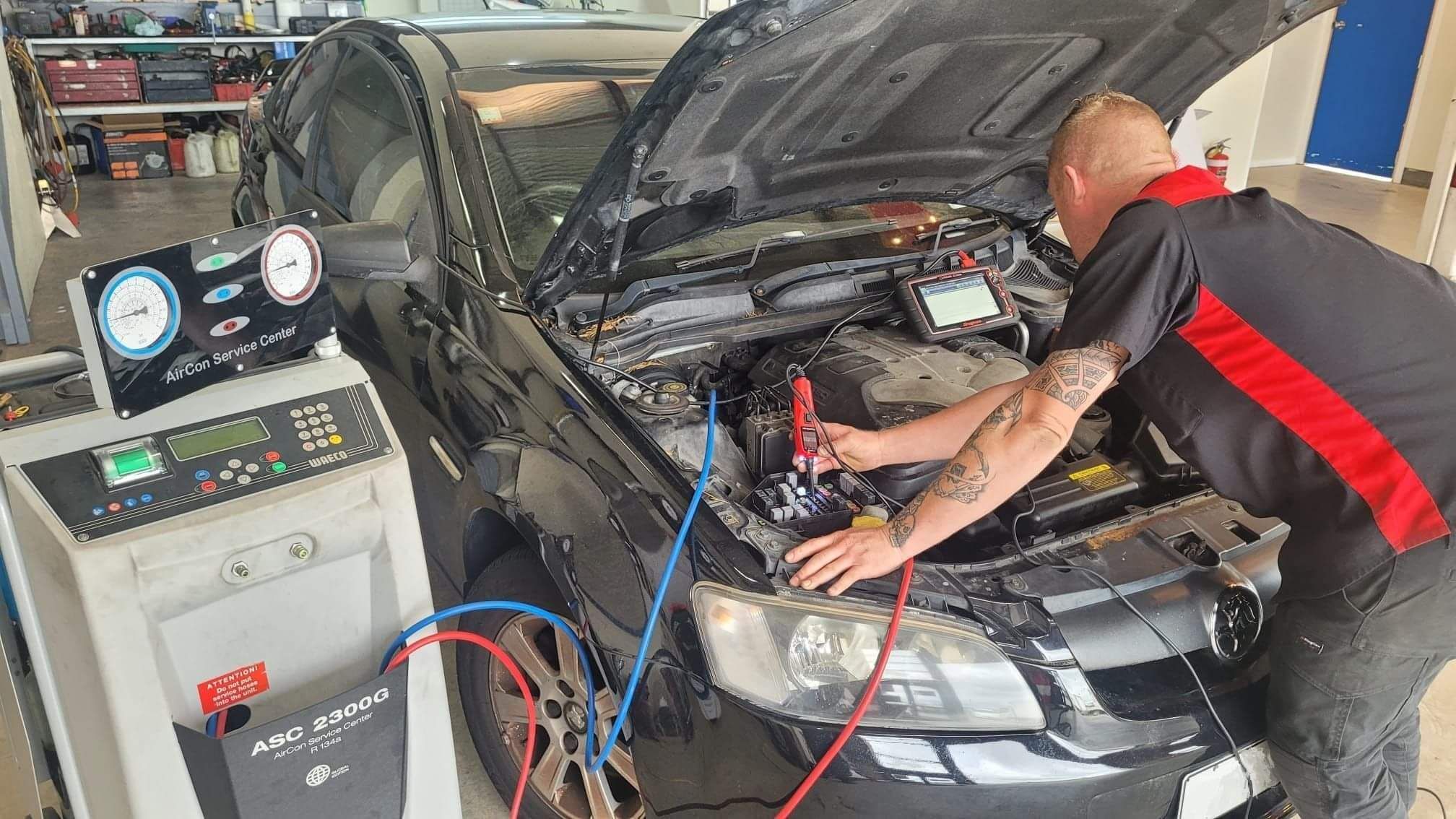
A/C RE-GASSING
An air-conditioning re-gas is required when a system has lost refrigerant through a leak, repair, component replacement or previous de-gassing. However, re-gassing alone is not an air-conditioning repair and for modern vehicles not a necessary service requirement. If your vehicle's air-conditioning system stops working because it is low on refrigerant, it will be leaking from somewhere and simply refilling it will not fix the fault, and will instead allow the refrigerant to escape again.
Our re-gas services are priced fairly and are always quoted prior to carrying out the work. We recognise we may not be the cheapest option however; we are committed to using the right pure refrigerant whether R134a, R1234YF, R744, and handling it responsibly. Re-gassing systems that have been properly assessed and confirmed to be not leaking to the manufacturers recommended charge weight.
The price of refrigerant has increased significantly in recent years, due to the carbon tax imposed on refrigerants and environmental regulations on synthetic greenhouse gasses. Due to the cost, we have seen a significant increase in counterfeit or unregistered refrigerants being sold within the industry at a much cheaper rate than refrigerant sourced ethically from registered suppliers. Unregistered refrigerant is very often unpure, full of contaminants, and/or comprised of miscellaneous refrigerants not intended for use in cars, which can often affect performance, damage parts and exacerbate repair costs. Cool Car is firm on only purchasing 100% pure and traceable refrigerant from registered suppliers to ensure that the refrigerant being used in our repairs and re-gasses is the right stuff.
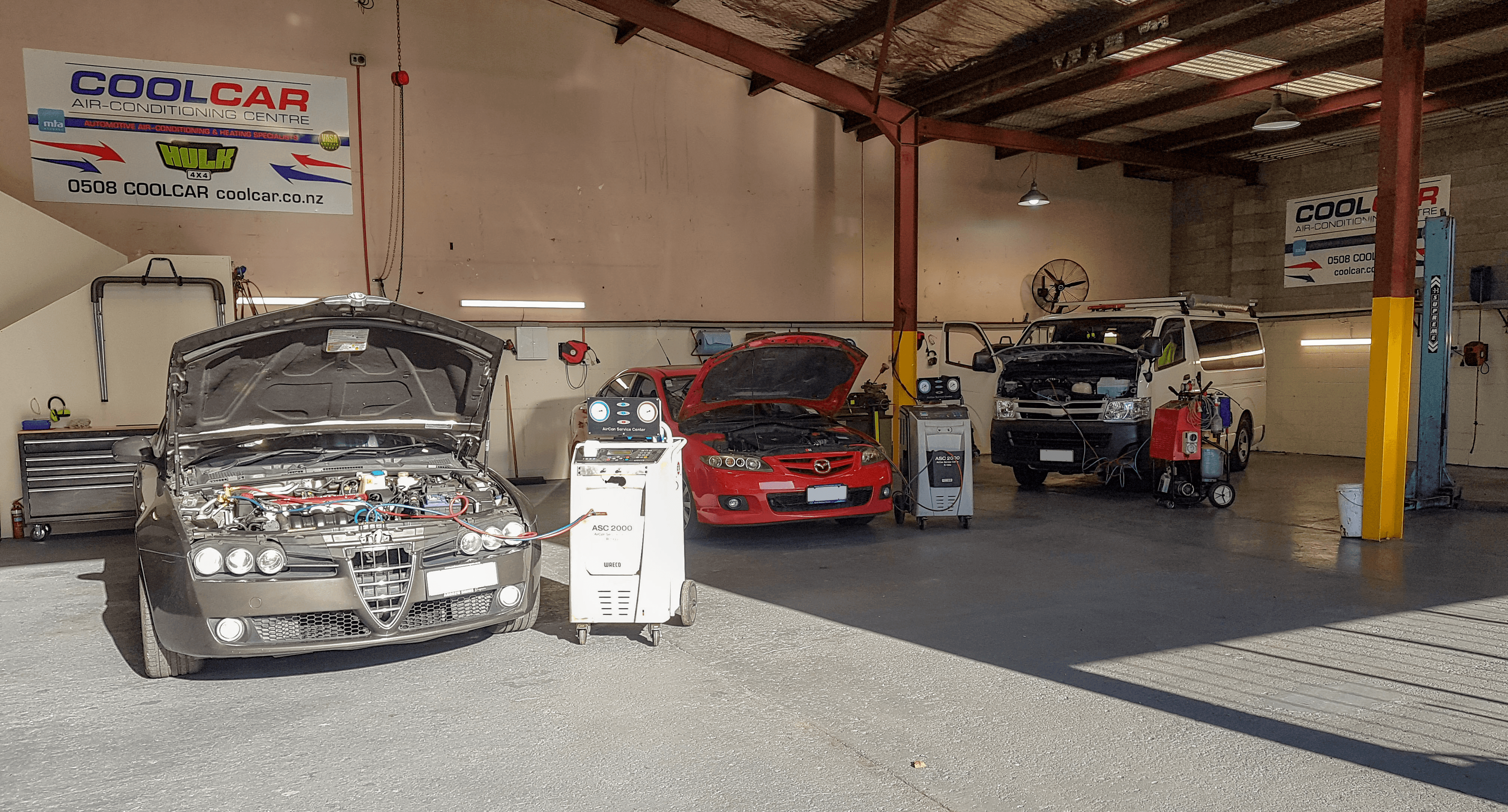
A/C DE-GASSING
De-gassing involves the safe recovery of refrigerant from and air-conditioning system prior to repairs, (HVAC, engine, panel repairs, etc). Refrigerant must not be released into the atmosphere. De-gassing at our workshops is performed free-of-charge.
CoolCar works with the CoolSafe Organisation New Zealand to recover refrigerant so that it can be disposed/destroyed responsibly.
REFRIGERANTS WE WORK WITH ||
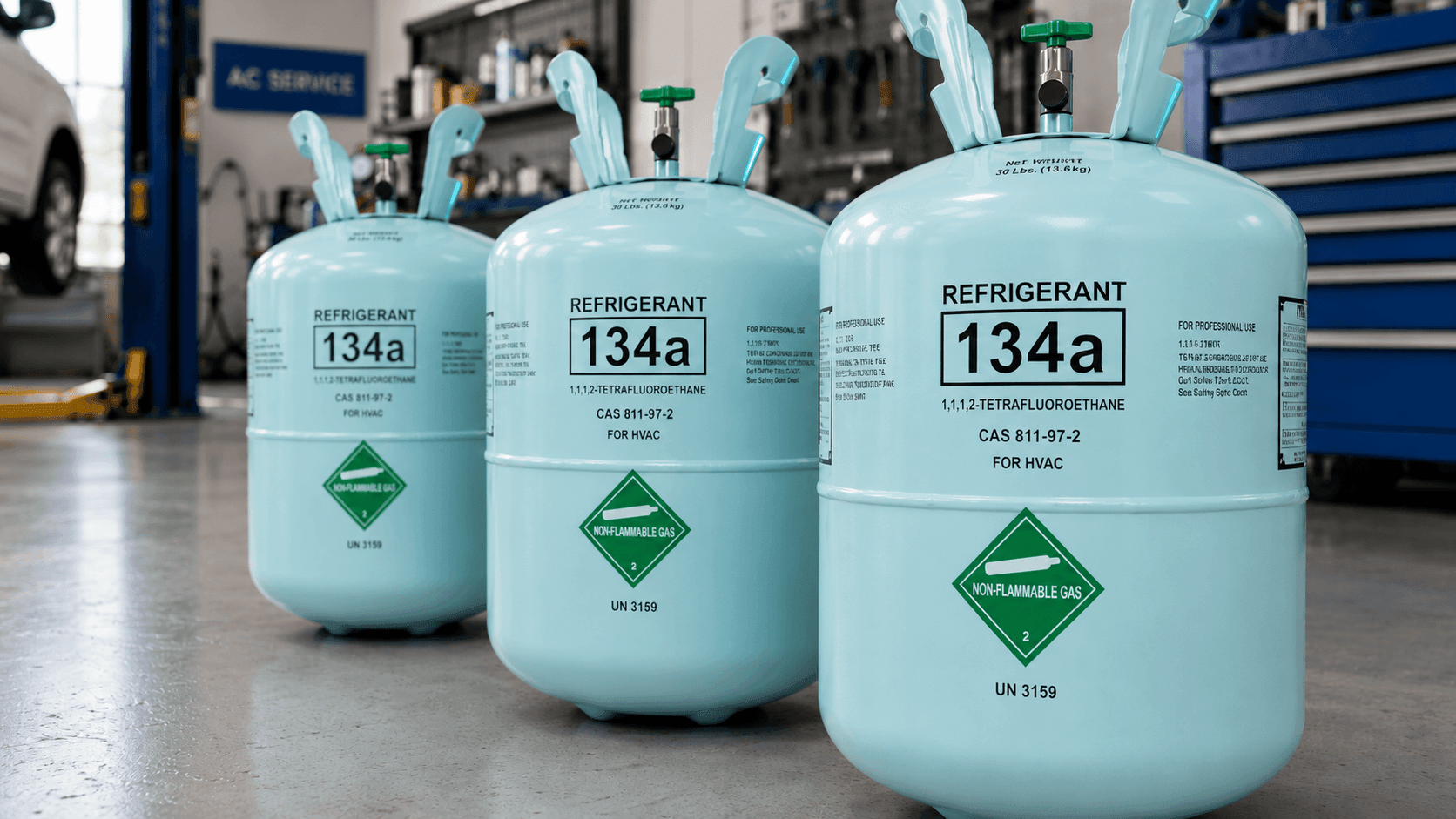
R134A REFRIGERANT
R134a is the refrigerant used in most air-conditioning systems. Instated in the early 1990's R134a was used to replace R-12 systems, as it was thought to be more environmentally friendly. R-134a is still found in the majority of vehicle's today.
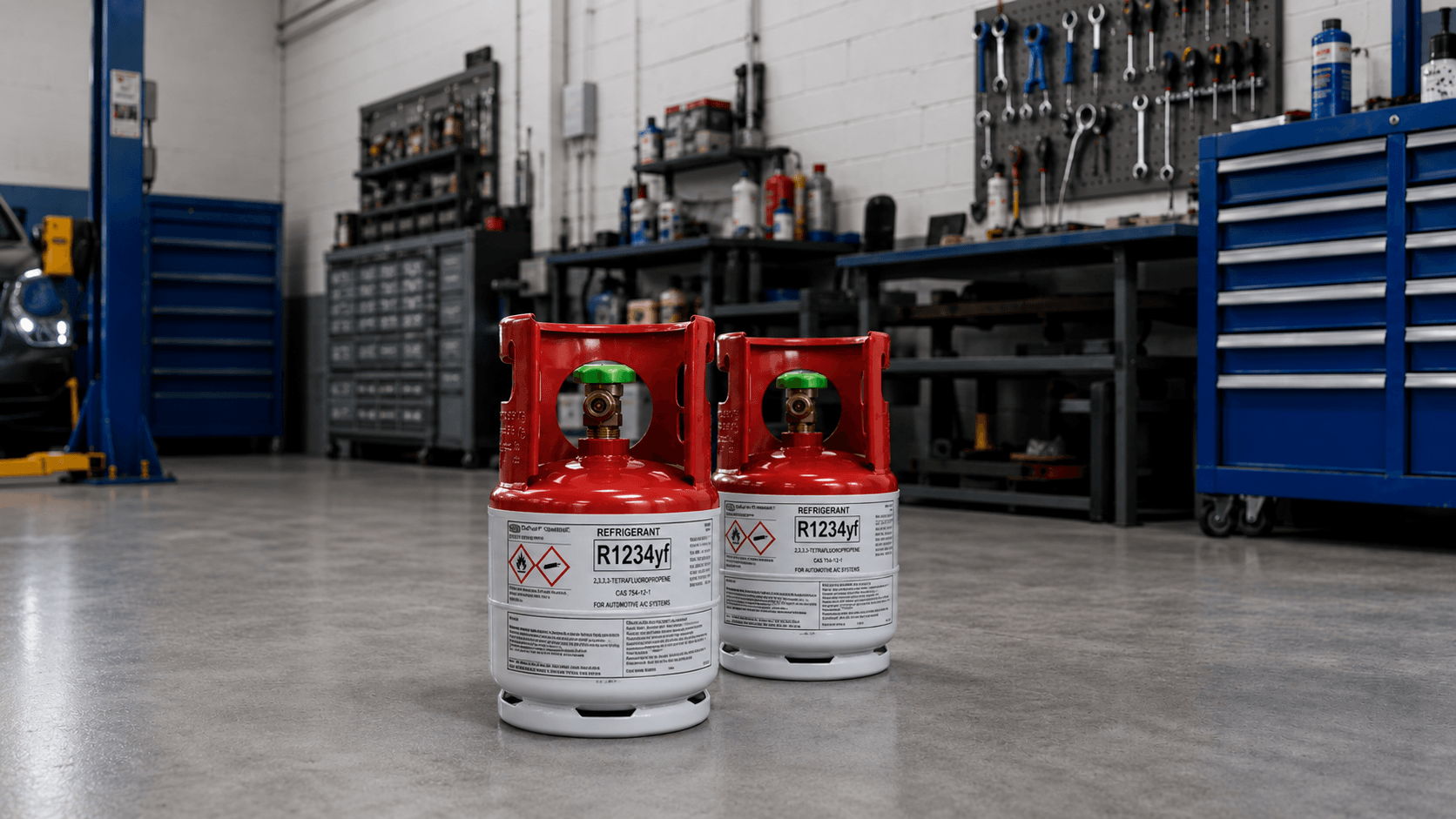
R1234YF REFRIGERANT
R1234YF Refrigerant is a new refrigerant released for commercial use in 2013, however, it is still not widely used in modern cars, with only a select few brands and car models that are being made to suit R1234yf refrigerant. R1234yf is profoundly more environmentally friendly than refrigerants of the past however, it is classed as mildly flammable and comes with a steeper price tag. Many workshops and dealerships cannot repair, de-gas or re-gas systems that use R1234yf, as it requires specialised diagnostic and recovery tools. CoolCar have profound experience with YF systems, as well as all the equipment.
R744/CO2 REFRIGERANT
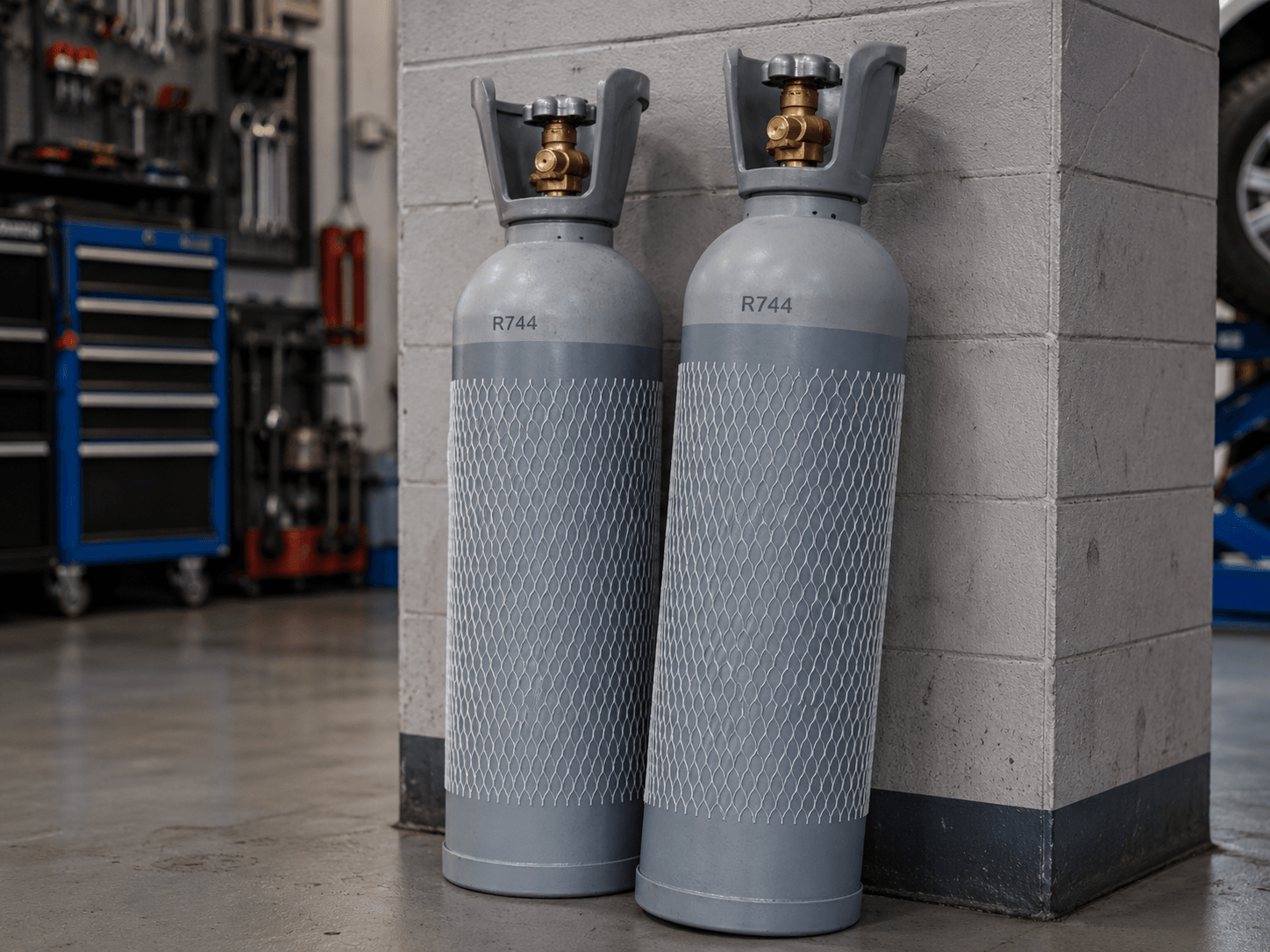
R744 Refrigerant systems is taking off in the luxury car world. And offers a highly efficient air-conditioning experience. R744 is comprised completely of CO2 and is non-toxic and non-flammable. It has a Global Warming Potential of 1, making it more environmentally friendly than any other refrigerant available however, R744 Refrigerant is required to run at a much higher PSI (up to 1400), than R1234yf or R134a air-conditioning systems which ensures that all tools related to diagnosing and repairing cars with R744 systems are highly specialised and expensive, and that system leaks in such a high-pressure system pose a significant safety risk.
WHY WE DON'T RE-GAS LEAKING A/C SYSTEMS
Long story short: Re-gassing an air-conditioning system that is known to be leaking compromises the environment and is an offence in New Zealand.
CoolCar understands that all vehicles today cannot feasibly lose enough refrigerant naturally at the fittings over the course of their lifetime to warrant requiring a re-gas or 'top-up'. If your vehicle is low enough on refrigerant that your A/C stops performing, there is a leak.
The most common refrigerants are comprised of synthetic greenhouse gasses. In the 1970s it was determined that R-12, the refrigerant that R-12, the refrigerant that catapulted automotive air-conditioning into relevancy was contributing to damaging the ozone layer. Thus R-12 was gradually phased out of production all together due to the Montreal Protocol in 1987. R-12 was superseded by R-134a, and is the most common refrigerant found in vehicle’s. These days R-1234YF and R-744 have also been put into use as they are more environmentally friendly.
Modern vehicle air-conditioning systems are sealed for a multitude of reasons. Both to keep the air out, and the refrigerant in the system where it belongs. Refrigerant should be recycled indefinitely, never ‘used-up.’ It is undeniable that over time a very small amount of refrigerant may be lost through normal permeation at joints & seals, however, any refrigerant naturally lost would never be enough to affect the performance of your vehicle’s A/C system - a defective or leaking part could.
New Zealand’s Environmental Protection Authority made it official in the Climate Change Response Act 2002, ensuring that any synthetic greenhouse gas being released into the atmosphere that was preventable would be considered an offence in NZ. This includes R-12 and R-134a. Refrigerant should only ever be properly recovered, handled and disposed rather than vented to the atmosphere.
Many workshops handling/dabbling in automotive air-conditioning are unaware of the extent of the effect refrigerant has on the environment and the illegality of releasing refrigerant to the environment when it is preventable and unnecessary.
At CoolCar, our process is to diagnose the cause of the refrigerant loss first. Once the fault or leak has been identified and repaired, the system can be evacuated, tested and then re-charged with the required refrigerant correctly. Ensuring that your vehicle’s air-conditioning system is performing as intended and that no excess refrigerant is unnecessarily lost to the atmosphere.
THE THREAT POSED BY REFRIGERANT/SYNTHETIC GREENHOUSE GASES
R-134a and many other refrigerants are comprised of synthetic greenhouse gases (SGG's). They are generally stable and safe to handle when contained correctly, however SGG's contribute to the Global Warming theory as they can trap significantly heat than carbon dioxide. This climate effect is measure using GWP.
Global Warming Potential (GWP): Is a measure of how much heat a greenhouse gas traps in the atmosphere within a general time frame of 100 years, when compared with the same amount of carbon dioxide. CO2 has a GWP of 1.
R-12: GWP of 10,900
R-134a: GWP of 1,430
R-1234yf: GWP of approx. 4
R-744/CO2: GWP of 1
As you can see it's imperative to retain refrigerant when necessary. In practical terms, releasing 1 kilogram of R-134a will have a 100-year warming effect equivalent to releasing around 1.43 tonnes of carbon dioxide. Newer refrigerants have much lower GWP's, which is why vehicle manufacturers are moving away from refrigerants of the past. However, no refrigerant should be unnecessarily released.
Recovering refrigerant, repairing leaks, and charging systems only once the system has been confirmed not leaking from the engine bay and behind the dashboard - helps reduce emissions, protects the environment and keeps the vehicle's air-conditioning system operating as intended.

AIR-CONDITIONING & HEATING QUESTIONS
Why is my car's air-conditioning system not blowing cold air?
The most common reason a vehicle’s air-conditioning system stops working properly is low refrigerant, usually caused by a leaking component somewhere in the system.
Your A/C system is designed to be sealed, so if refrigerant is low, it has usually escaped through a leak. Common leak points can include the condenser, compressor, evaporator, hoses, seals, or pipework.
Before we re-gas the vehicle, we need to identify and repair the cause of the leak. This is important because any refrigerant we put into the system will simply escape again if the faulty component is not repaired or replaced first.
At CoolCar, our goal is to fix the root cause of the problem, not just temporarily refill the system. Once the leak has been repaired, we can evacuate, test, and re-gas the system properly so your air-conditioning has the best chance of staying cold and reliable.
Why does my car's air-con only work sometimes, like in the morning?
The most common reason for intermittent air-conditioning performance is gradually depleting refrigerant, usually caused by a leak somewhere in the system.
Refrigerant is what allows the A/C system to absorb heat and cool the air before it comes through your vents. When the refrigerant level drops, the system may still work when the outside temperature is mild, such as in the morning or evening, because the A/C does not have to work as hard.
However, once the day heats up, especially in the middle of the day, the system needs to perform under much greater pressure and heat load. If the refrigerant level is too low, or another component is weak, the A/C may stop cooling properly just when you need it most.
This is why many customers find their A/C seems fine first thing in the morning, but struggles or stops working when the weather is hotter.
At CoolCar, we test the system to find the cause of the problem rather than simply re-gassing it. If refrigerant is low, there is usually a leak that needs to be found and repaired before the system is re-gassed properly.
Why does my car's A/C keep needing to be re-gassed?
If your car’s air-conditioning keeps needing to be re-gassed, it usually means there is a leak somewhere in the system.
A vehicle A/C system is designed to be sealed. Refrigerant should not simply “run out” through normal use. If the refrigerant level is low, it has escaped from somewhere; commonly through a leaking condenser, compressor, evaporator, hose, seal, or pipework.
A re-gas on its own is only a temporary fix. Depending on the size of the leak, a re-gas may last anywhere from a few days to a couple of years, but the underlying problem is still there.
At CoolCar, we focus on finding and repairing the cause of the refrigerant loss before re-gassing the vehicle. This gives your A/C system the best chance of staying cold, reliable, and properly repaired, rather than needing repeat top-ups.
Why does my vehicle's air-conditioning system stop working when in traffic?
If your air-conditioning works while you are driving but stops cooling properly in traffic, it often means the system is struggling when there is less airflow through the front of the vehicle.
When you are moving, natural airflow helps cool the condenser at the front of the vehicle. When you are stopped or moving slowly in traffic, the system relies much more heavily on the cooling fans to keep temperatures and pressures under control.
Common causes include:
Faulty condenser or radiator fans
Low refrigerant caused by a leak
A blocked, dirty, or damaged condenser
Weak compressor performance
Pressure sensor or fan control faults
Electrical relay, fuse, or wiring problems
Engine cooling system issues affecting A/C performance
If the condenser cannot get rid of heat properly, the A/C may stop cooling, cycle on and off, or blow warm air when the vehicle is stationary.
At CoolCar, we test the A/C system under the right conditions to find out whether the issue is caused by airflow, fan operation, refrigerant level, pressure control, or another fault. Once we have confirmed the cause, we can explain the repair options before proceeding.
How do you look for leaks?
Our initial A/C inspection includes leak detection. We check the system carefully using a combination of visual inspection, hands-on testing, and specialised electronic leak detection equipment.
Some leaks can be found by looking for signs such as oil staining, damaged components, worn seals, corrosion, or obvious refrigerant residue around common leak points like the condenser, compressor, hoses, pipework, and fittings.
If the leak is harder to find, we may recommend a tracer gas test. This involves pressurising the system with a specialised test gas, then using a highly sensitive hydrogen leak detector to trace where the gas is escaping.
Tracer gas testing is especially useful for small or hidden leaks, including leaks behind the dashboard or in areas that are difficult to access. It allows us to pinpoint the source of the leak more accurately before recommending the right repair.
How much will it cost to fix my air-conditioning?
It is difficult to provide an accurate repair price without inspecting the vehicle first, because air-conditioning faults can have several different causes.
In many cases, A/C problems are caused by a refrigerant leak. The cost of repair depends heavily on where the leak is coming from and which component needs to be repaired or replaced. For example, a leaking seal, hose, condenser, compressor, or evaporator can all involve very different parts and labour requirements.
That is why we carry out an initial inspection first. This allows us to diagnose what has caused the problem, identify the faulty component, and prepare a proper quote for the complete repair, including labour.
Once we know what is required, we’ll explain the issue, outline the repair options, and provide a quote before proceeding with the work.
Can you repair rear air-conditioning faults in vans, SUV's and people movers?
Yes! Not only can we diagnose rear A/C faults and test them for leaks but we can also install rear air-conditioning and roof-top A/C units into almost all vehicles. An air-conditioning evaluation is necessary first so that we can get an understanding as to the layout and electrical components inside the car to quote the necessary modifications and/or repairs.
Is there any consequence to re-gassing a leaking air-conditioning system?
Yes! Refrigerants, R22, R134a, R12 and R1234YF are all synthetic greenhouse gasses meaning they have great Global Warming Potential and are subsequently harmful to the environment and ozone layer.
Additionally, running your vehicle's A/C system with less than the intended amount of refrigerant for your vehicle can A) Alter the pressure inside the A/C system and force leaks, B) Upset modern day compressors by having them pump less refrigerant than their programmed to, and C) Seize compressors, as when the refrigerant is leaking out, so is the oil that lubes up the spinning compressor bearing.
As this is a mechanical component it requires lubricant to keep spinning. This can also escalate to the compressor spitting metal filings through your car's A/C system, ensuring all the parts must be flushed or replaced to remove the metal filings. Compressors are the 'heart' of the A/C system, they are not cheap to replace, hence it's best to keep it healthy by ensuring the refrigerant is kept exactly where it should be.
Can A/C issues cause my car to be smelly?
Yes, a smelly car can be caused by the air-conditioning system.
Moisuture naturally builds up around the evaporator inside the dash when the A/C is running. Over time, this damp environment can allow bacteria, mould, mildew, dust and organic matter to build up, which can create an unpleasant smell through the vents.
After a preliminary check to judge whether the smell is mildew related or that you're smelling refrigerant and oil from a leaking evaporator; We may recommend a deodorisation treatment, depending on the vehicle and the type of smell being emitted from the vents. A deodorisation treatment typically includes an ozone machine, and bactigas treatment, and/or an anti-fungal/bacterial treatment applied to the evaporator coils to help reduce bacteria, mould and odour at the source. We'll also consider the replacing the cabin air filter, if upon inspection it is filthy.
Why are my window's not demisting?
If your windows are not demisting properly, it is likely because your vehicle's heating, air-conditioning or ventilation system is not working as it should. Some don't realise that the A/C system helps to demist your windows, even during the winter time. The A/C removers moisture from the air before it is blown onto the glass, which aids in clearing condensation much faster.
If your demister is blowing air but the windows stay foggy, the system may not be drying or directing the air properly. If the airflow is weak, there may be a blockage, filter issue or fan fault.
We'll check your A/C, heating, cabin filter and airflow to find out why your windows are not clearing as they should. Having established the cause, we can recommend the best repair or treatment to get your demister working as it should.
Some common issues of poor demisting include:
Low refrigerant or an A/C system fault
A blocked or dirty cabin filter
Weak airflow from the vents
A faulty blower fan
Heater or temperature control issues
Recirculation mode staying on
Blocked vents or air intake areas
Excess moisture inside the vehicle
Water leaks into the cabin
Faulty heater controls, blend doors, or actuators
What models of car's can you work on?
CoolCar are air-conditioning & heating specialists we can fit or repair air-conditioning systems to all vehicles; cars, trucks, tractors, boats, trains and planes, etc. We've been in business for a long time, and have a raft of experience. No model of car is out of our expertise:
Abarth
Acura
Alfa Romeo
Alpine
Aston Martin
Audi
BAIC
Bentley
BMW
Borgward
Bugatti
Buick
BYD
Cadillac
Changan
Chery
Chevrolet
Chrysler
Citroën
Cupra
Dacia
Daewoo
Daihatsu
Dodge
Dongfeng
DS Automobiles
Ferrari
Fiat
Fisker
Ford
Foton
GAC
Genesis
Geely
GMC
Great Wall
Haval
Holden
Honda
Hongqi
Hyundai
Infiniti
Isuzu
Iveco
JAC
Jaguar
Jeep
Kia
Koenigsegg
Lamborghini
Lancia
Land Rover
LDV
Leapmotor
Lexus
Lincoln
Lotus
Lucid
Mahindra
Maserati
Mazda
McLaren
Mercedes-Benz
MG
Mini
Mitsubishi
Nissan
Opel
Pagani
Peugeot
Polestar
Pontiac
Porsche
Proton
Ram
Renault
Rivian
Rolls-Royce
Saab
SEAT
Škoda
Smart
SsangYong / KGM
Subaru
Suzuki
Tata
Tesla
Toyota
Vauxhall
Volkswagen
Volvo
Wuling
XPeng
Zeekr
Can you supply A/C parts to me so that I can do the work?
Yes of course! CoolCar are more than happy to source and sell parts. Let us know what part you're after and we'll provide price and availability. Upon your confirmation we can organise for the parts to be sent to you or collected from our premises. All parts purchased will be sold with a 12 month warranty unless stated otherwise.
Are there any car's models prone to air-conditioning issues?
Yes! Unfortunately, there are plenty of makes and models that are much more prone to air-conditioning issues than others. Examples include:
Hyundai Ionic
Hyundai Kona
Kia Sorento
Mazda CX-5
Ford Ranger
Honda Civic
These are just a few popular models that are prone to specific air-conditioning faults. Cool Car has spent decades compiling practical knowledge of common faults across a wide range of vehicles. In some cases, we have also developed repair methods that address manufacturing issues rather than simply replacing failed parts and leaving the same underlying issue to happen again. Our goal is to carry out repairs that are accurate, durable, and appropriate for the vehicle.
What refrigerants can you work with?
CoolCar are automotive air-conditioning specialists, we are proficient with repairs on not only r134a refrigeration systems, but also the newer r1234yf refrigeration systems.
Additionally, CoolCar are the ONLY automotive air-conditioning repairer that can diagnose and repair air-conditioning issues on cars that run an R744/CO2 refrigerant, such as S-Class Mercedes, in the entire Southern Hemisphere.
GENERAL QUESTIONS
Can you fit customer supplied parts?
Yes, CoolCar are happy for customers to source their own parts if that is your preference, however having not purchased parts ourselves, and without knowing where they came from, we cannot offer any kind of warranty on a part we did not supply. Parts we supply however have a 12-month warranty.
What happens if parts are hard to find?
CoolCar has its very own parts-finding-specialists. We've been in the industry for a very long time, and had the chance to build a lot of connections. It is very rare for CoolCar to be unable to find parts suitable for your vehicle.
Our general procedure is to find parts and quote the repair accordingly during the initial 20-45min inspection that we perform on your car. However, on the off-chance that we do need to spend more time searching for the right bits, or speak to our suppliers, we'll will provide a written explination as to what we have found and the parts required, and get back to you with pricing once we have had more time to investigate.
if customer would prefer a second hand component the warranty is either limited to 3 months, or the suppliers guarantee.
Should I book in advance before coming in?
During the Summer it is imperative that you book in prior to coming in to see us, However, we often still have same-day slots available to be booked, and will go above and beyond to fit you in when it suits you best. We are a Summer seasonal business and are often booked solid during this period, regarding all things, motorhomes, auto electrical and air-conditioning.
In our off season, the Winter period is much slower, you have a much better chance of being seen to as soon as you walk in the door.
Do you use aftermarket or genuine parts for repairs?
CoolCar primarily use aftermarket parts for repairs, as they are generally cheaper, more accessible and better reinforced than OEM parts. However, depending on availability OEM parts may be necessary. CoolCar can also fit second-hand parts either according to necessity or customer preference. However, second-hand part usage has a bearing on the provided warranty.
Can you supply A/C parts to me so that I can do the work?
Yes, CoolCar are happy for customers to source their own parts if that is your preference, however having not purchased parts ourselves, and without knowing where they came from, we cannot offer any kind of warranty on a part we did not supply. Parts we supply however have a 12-month warranty.
Can you inspect multiple issues in one visit?
This depends on the scale of the two issues. Extra time may be required to examine the extent of your troubles, as well as additional charges, that would be discussed prior. takled on a case by case basis.
What model's of car's do you work on?
Enter youCoolCar are air-conditioning & heating specialists we can fit or repair air-conditioning systems to all vehicles; cars, trucks, tractors, boats, trains and planes, etc. We've been in business for a long time, and have a raft of experience. No model of car is out of our expertise:
Abarth
Acura
Alfa Romeo
Alpine
Aston Martin
Audi
BAIC
Bentley
BMW
Borgward
Bugatti
Buick
BYD
Cadillac
Changan
Chery
Chevrolet
Chrysler
Citroën
Cupra
Dacia
Daewoo
Daihatsu
Dodge
Dongfeng
DS Automobiles
Ferrari
Fiat
Fisker
Ford
Foton
GAC
Genesis
Geely
GMC
Great Wall
Haval
Holden
Honda
Hongqi
Hyundai
Infiniti
Isuzu
Iveco
JAC
Jaguar
Jeep
Kia
Koenigsegg
Lamborghini
Lancia
Land Rover
LDV
Leapmotor
Lexus
Lincoln
Lotus
Lucid
Mahindra
Maserati
Mazda
McLaren
Mercedes-Benz
MG
Mini
Mitsubishi
Nissan
Opel
Pagani
Peugeot
Polestar
Pontiac
Porsche
Proton
Ram
Renault
Rivian
Rolls-Royce
Saab
SEAT
Škoda
Smart
SsangYong / KGM
Subaru
Suzuki
Tata
Tesla
Toyota
Vauxhall
Volkswagen
Volvo
Wuling
XPeng
Zeekrr content...
Why do some of your branches have an initial inspection fee?
All of our branches at CoolCar have an initial inspection unless there is a promotion going on to discount or make inspection's free of charge.
Do you supply courtesy or loan cars whilst my car is with you?
Yes! CoolCar has a fleet of courtesy available to be provided to you. These cars are regularly maintained and are free of charge for your conveince. However, CoolCar is not responsible for filling these vehicle with petrol, nor do we expect you to bring the cars back with a full tank. Fuel is your responsibility,. If the car's are in high demand we prefer to have them reserved for customers going ahead with repairs, instead of for those who just have evaluation bookings.
What payment methods do you accept?
CoolCar accepts Visa, Master Card, Eftpos, Cash, contactles and afterpay payments methods. Additionally, all online transactions made when booking your vehicle in are secured with Stripe.
Can I drop my vehicle off before or after your working hours?
CoolCar are happy for you to drop your vehicle off outside of our business hours, and have secure locations for you to leave your keys. However, CoolCar cannot take responsibility for your leaving your vehicle parked outside. Please phone to arrange this.
Do I need to pay a deposit?
Deposits are generally not necessary, however, if we need to order parts internationally, generally not returnable, and with a transit time 7-10days, we may request a deposit to cover the cost of the part and the associated freight.
What should I bring with me to my appointment?
Yourself, your vehicle and any associated paperwork you may have if you've attempted to have the issue repaired or diagnosed elsewhere.
Can I have my car repaired under my Mechanical Breakdown Policy?
Absolutely. If you've purchased your vehicle from a second-hand car dealership within the last three years, you may have also purchased a Mechanical Breakdown Policy. If so, you can claim air-conditioning and heating repairs on your policy.
CoolCar will handle opening the claim and liaising with your Insurance company to provide the necessary information and receive confirmation on repairs. Depending on the policy you purchased and the Insurer, has a bearing on any exclusions from the policy, which are then owed by the customer. We may also ask to have previous service documents provided, as required by your insurance company.
Upon having the quote approved by your insurance company, we will then get in touch to discuss your share with you. Upon your acceptance, we will proceed with the necessary repairs.
What warranty do you offer on your repairs?
All our repairs come with a 12-month warranty on the repairs performed. This includes warranty on labour, parts and refrigerant used in the repair. Unless stated otherwise due to the condition of parts. (Any exceptions will firmly be discussed with you when you receive the quote to ensure your understanding and permission).
If your vehicle happens to return with an air-conditioning fault, or part leaking unrelated to the repairs we've performed within the last 12-months. Refrigerant and some sundries will be covered under warranty, however, any parts and labour unrelated to the original repair will not be covered.